
Written By: Shantel Kalakalo, President, Kalham Consulting, Kelly McFayden, Director, Condo Lending Group and Ryley Schmidt, Associate, Miller Thomson LLP
Condominium corporations rarely find themselves in financial difficulty overnight. More often, financial crises develop gradually through years of rising construction costs, aging building components, deferred maintenance, outdated reserve fund assumptions, or simply a reluctance to make difficult financial decisions.
By the time a roof begins leaking, balconies require structural repairs, or the building envelope reaches the end of its service life, boards may discover that the reserve fund is no longer sufficient to cover the work.
The encouraging news is that most financial crises are preventable.
During the Alberta Condo Expo (ACE), industry experts Shantel Kalakalo, President of Kalham Consulting, Kelly McFadyen, Director at Condominium Lending Group (project financing), and Ryley Schmidt, Associate at Miller Thomson LLP, shared practical strategies for helping condominium corporations avoid funding shortfalls, and navigate them effectively when they do occur.
Their message was clear: financial crises are rarely just about money. More often, they result from delayed planning, insufficient communication, and postponed decision-making.
Key Takeaway
Strong planning + timely decisions = stronger communities
A healthy reserve fund doesn’t happen by accident. It requires regular review, realistic budgeting, and a willingness to address problems before they become emergencies.
It Starts Long Before the Money Runs Out
Under Alberta’s Condominium Property Act, condominium corporations have a legal, ongoing duty to maintain and repair common property and fund future replacements through a reserve fund. That obligation doesn’t disappear simply because funding is limited.
The best boards take a proactive approach by identifying aging components early, obtaining professional assessments, updating project costs, and incorporating those findings into a realistic reserve fund plan. Waiting until a component fails often leaves fewer options and significantly higher costs.
Unfortunately, reserve fund studies can become outdated almost as soon as they are completed. Construction inflation, supply chain challenges, and labour shortages have changed project pricing dramatically over the past several years. A reserve fund plan based on estimates from even a few years ago may no longer reflect today’s reality.
Rather than treating the reserve fund study as a document that sits on a shelf until the next legislative update, boards should view it as a living financial roadmap that deserves regular review.
Board Planning Checklis
Before approving next year’s budget, ask:
- ✔ Is our reserve fund study less than five years old?
- ✔ Have project costs been updated using current market pricing?
- ✔ Have we reviewed expected repairs over the next five years?
- ✔ Are annual reserve contributions keeping pace with inflation?
- ✔ Have we discussed known concerns with our reserve fund provider or engineer?
Why Reserve Funds Fall Behind
Reserve fund shortfalls rarely have a single cause. Instead, several factors often combine over time.
A condominium corporation may postpone a large project to reduce immediate costs, only to discover that construction prices have increased substantially by the time the work becomes unavoidable. Unexpected failures, changing building conditions, severe weather events, or new code requirements can also accelerate repair schedules.
Sometimes the reserve fund itself isn’t the problem. Rather, the assumptions behind the funding plan are no longer accurate.
Warning Signs Your Corporation May Be Heading for a Funding Gap
- Major repairs continue to be postponed.
- Reserve contributions have remained unchanged despite rising construction costs.
- Emergency repairs are becoming more frequent.
- The reserve fund study no longer reflects current pricing.
- Building components are aging faster than anticipated.
- Owners are surprised whenever significant repairs are discussed.
Recognizing these warning signs early gives boards far more flexibility than waiting until a crisis develops.
When the Reserve Fund Isn’t Enough
Discovering that a major project cannot be fully funded from the reserve account does not necessarily mean the corporation is in crisis. It does, however, mean the board needs to carefully evaluate both the scope of the work and the available funding options.
One mistake boards sometimes make is discussing funding before determining exactly what work needs to be completed. Instead, the experts recommend addressing the project first.
Can the repair safely, fairly, and economically be phased over several years? Would a targeted repair extend the life of the component? Is immediate replacement necessary because of safety concerns or water intrusion? These questions should be answered with professional advice before deciding how to pay for the project. (TABLE 1)
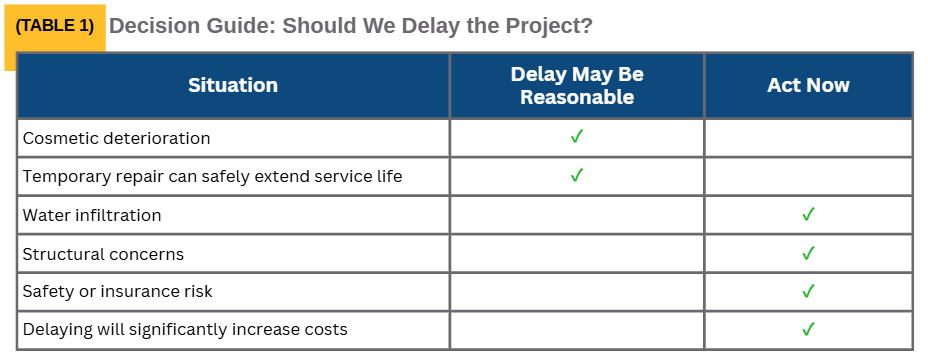
While delaying work may appear attractive in the short term, it often results in larger repair bills, additional property damage, insurance concerns, and greater disruption for residents.
Choosing the Right Funding Solution
Every condominium corporation is different, which means there is rarely a single “correct” way to fund a major capital project.
Boards should compare several approaches while considering owner affordability, long-term reserve health, borrowing capacity, and future repair needs. (TABLE 2)

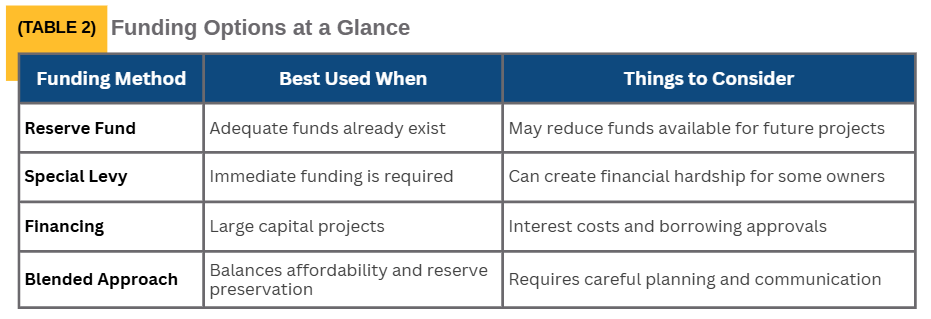
Scenario planning can also help owners understand the practical implications of each option. Rather than presenting only one solution, boards should explain the advantages, costs, and risks associated with each approach whenever possible.
Communication Is One of the Board’s Most Important Tools
Even well-planned projects can become contentious if owners feel they have been left out of the process.
Transparent communication builds trust and helps owners understand not only what decisions are being made, but why those decisions are necessary.
Information meetings provide an opportunity for engineers, reserve fund professionals, contractors, legal counsel, and lenders to answer questions directly before major decisions are finalized.
Owners Want to Know
When communicating a major project, boards should clearly explain:
- What problem has been identified.
- What professional advice has been received.
- What options were considered.
- Why the recommended solution was chosen.
- How the project will be funded.
- What the financial impact will be for owners.
- What risks exist if the work is delayed.
- What happens next.
Owners are far more likely to support difficult decisions when they understand the process that led to them.
Looking Beyond Today’s Repair
Every major repair presents a balancing act.
Boards must address today’s problems while ensuring that tomorrow’s projects remain adequately funded. Solving one issue by completely depleting the reserve fund may simply postpone another financial crisis a few years down the road.
Successful condominium corporations should focus on long-term financial resilience rather than short-term relief. Reserve fund contributions should be reviewed regularly, funding plans updated as conditions change, and major decisions documented carefully to provide continuity for future boards.
Financial stability isn’t achieved by avoiding difficult conversations. It comes from having those conversations early, relying on qualified professional advice, and making informed decisions before options become limited.
Five Questions Every Board Should Ask
Before approving a major capital project, ask:
- Have we obtained current professional advice (i.e., engineering, legal, accounting, etc.)?
- Are our project costs based on today’s market?
- Have we compared multiple funding options?
- Have we clearly communicated the impacts to owners?
- Will this decision protect the corporation’s long-term financial health?
By planning ahead, reviewing reserve fund assumptions regularly, and communicating openly with owners, boards can significantly reduce the risk of financial crisis while protecting both the community and the value of every owner’s investment.
About the Authors
Shantel Kalakalo is President and Partner of Kalham Consulting Ltd., with 20+ years of condominium industry experience specializing in Reserve Fund Studies.
Kelly McFayden specializes in condominium financing and reserve fund shortfalls. With 20+ years of experience, she recently joined Condominium Lending Group after beginning her career with CWB.
Ryley Schmidt is a civil litigation and real estate lawyer specializing in condominiums and cooperatives, with experience in governance, bylaws, collections, construction, and project financing.