
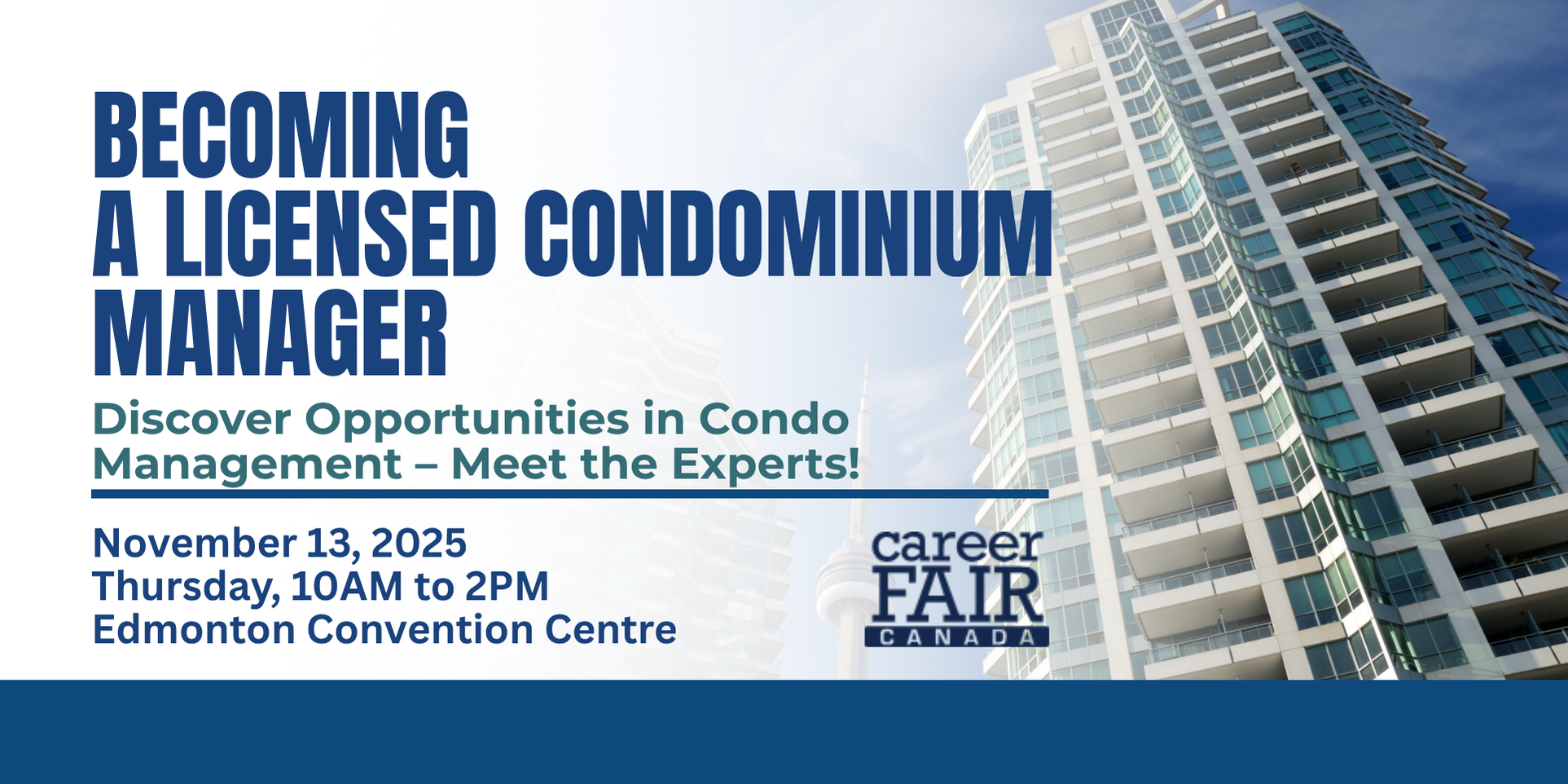
Whatever your situation, explore the dynamic, rewarding field of condominium management.
DATE: Wednesday, December 3, 2025
Thursday, 10AM to 2PMM
Edmonton Convention Centre
Condominium management is a dynamic field that is often challenging yet personally rewarding, offering significant growth opportunities. In this role, you will apply and expand various skills focused on stewardship, enabling you to impact people’s lives by:
• Supporting the Board of Directors in their mandates.
• Ensuring condominium corporations adhere to bylaws and legislation.
BENEFITS OF A CAREER IN CONDOMINIUM MANAGEMENT
With so many career choices in the modern job market, why consider a career in condominium management?
• Continuous learning and professional development in areas like strategic planning and negotiations, and problem-solving techniques.
• Career stability and personally rewarding.
Opportunities for career development and networking include a competitive salary, a diverse portfolio of condominium properties, and the chance to foster a positive condominium community.
HISTORY
Alberta began adopting formal condominium statutes in the 1960s. The province created a framework allowing individual title to units within a building, with common property and shared obligations, governed by a condominium corporation.
The first condominium legislation in Canada, the Condominium Property Act of Alberta, was passed by the Alberta Legislature on August 1, 1966. On December 20, 1967, the first condominium Plan was filed at the Land Titles Office creating the Brentwood Village Condominium Corporation in northeast Edmonton. This corporation enjoys the status of being the first condo corporation created in Canada.
Condominiums have been part of Alberta’s housing landscape since then and they have grown in popularity ever since. That growth occurs not just in numbers of units or corporations, but also in the workforce, industry practices and the laws that govern it all.
DIFFERENT TYPES OF CONDOMINIUMS IN ALBERTA
Various types of buildings are designated as condominiums in Alberta; however, not all of these structures include residential components. The following outlines the most prevalent forms of condominiums:
1. Residential – meant for residential use
2. Conversion – apartment or warehouse turned into a condominium
3. Industrial or Commercial – business vs. residential use
4. Bare Land – the Unit owns the land that their unit is on
5. Recreational – connected to recreational activities
6. Mixed Use – commercial and residential
Even if these condominiums have different uses, they do have a few things in common:
• They are all corporations
• They all require dedicated management
• They all have individual units
If you are an individual or business in Alberta engaged in providing condominium management services, it is required that you
possess a licence issued by RECA. Obtaining an Alberta condominium management license is a multi-step process. The following provides a brief overview of
this procedure. Please refer to the RECA website for additional information regarding this process:
STEP 1: DETERMINE YOUR ELIGIBILITY
To be eligible to enrol in pre-licensing education, you must:
• be at least 18 years of age
• be a Canadian permanent resident or citizen
• be able to provide an accepted form of valid governmentissued identification (ID)
• have a minimum of Canadian high school education or equivalent
• provide proof of your English language skills
STEP 2: EDUCATION
Once a condominium manager has fulfilled the educational and examination requirements, they may apply for the official license through RECA. The license is not merely a formality; it signifies a commitment to uphold professional standards and adhere to the framework established in legislation. To qualify for a condo manager license, individuals must complete two mandatory courses:
1. Fundamentals of Condominium Management
2. Practice of Condominium Management
These courses cover critical areas such as governance, financial management, communication with residents and boards, and legal obligations under the Condominium Property Act.
STEP 3: WORKING UNDER A LICENSED BROKERAGE
Candidates may be employed by licensed condominium management brokerages in a support capacity while undertaking their pre-licensing courses; however, they are prohibited from assuming the duties and responsibilities of a licensed condominium manager. Subsequently, upon fulfilling their educational prerequisites, they are required to work under the supervision of a licensed brokerage. This measure ensures that condominium managers acquire practical experience and operate under the mentorship of experienced professionals. The brokerage provides a support system that offers oversight and guarantees adherence to industry regulations.
STEP 4: OBTAINING A LICENSE
Once a condominium manager has fulfilled the educational and examination requirements, they may apply for the official license through RECA. The license is not merely a formality; it signifies a commitment to uphold professional standards and adhere to the framework established in legislation.