
Written by: Walter Wakula, BComm, MBA, ICD.D., President of Foothills Global Capital Group Inc.
This article was originally published in 2023 as a three part series in CCI South Alberta’s CCI Review. It has been updated and consolidated into one article for reprint here.
The condominium corporation’s reserve fund is typically its largest financial asset aside from the physical property itself. More than 20 percent of condo fees often flow into this fund, and with construction and equipment costs rising faster than general inflation, how the reserve fund is invested has become increasingly important. Sound investment practices can help preserve purchasing power and reduce the risk of future funding shortfalls, while poor decisions can erode value and expose directors to unnecessary risk.
This article outlines the legislative framework governing reserve fund investments, the importance of investment policy and objectives, practical portfolio structure, and a proven strategy for investing the guaranteed investment certificate (GIC) portion of the fund.
Legislative Framework: Condominium Property Act (CPA)
To protect owners from speculative or inappropriate investing, the Condominium Property Act (CPA) strictly limits the types of investments a condo board may make. Permitted investments include high-quality common and preferred shares, bonds and debentures, and fixed-income securities such as GICs issued by banks, trust companies, credit unions, and similar institutions.
The CPA also imposes asset allocation limits to enforce diversification and risk control:
- Common shares: maximum 15% of the reserve fund
- Bonds, debentures, and preferred shares: maximum 35%
- At least 50% must be invested in lower-risk instruments such as GICs
Many corporations further restrict these investments through bylaws or board-approved policies to reflect a conservative risk tolerance. Safety of principal and liquidity should always take precedence over chasing higher returns.
Investment Policy and Governance
Before investing reserve fund assets, the board should adopt a formal investment policy. This policy should:
- Reference the CPA and any applicable investment bylaws
- Clearly state the investment objectives (e.g., capital preservation, liquidity, inflation protection)
- Define acceptable asset classes and allocation limits
- Outline decision-making processes and delegated authorities
- Establish requirements for professional investment advice
Boards should avoid relying on individual directors’ personal investment opinions. Managing reserve fund investments requires expertise in financial markets, credit analysis, interest rate cycles, and risk management—skills typically beyond the scope of volunteer directors.
Investment Objectives: Keeping Pace with Inflation
A key objective of reserve fund investing is ensuring that returns exceed inflation. This is critical because the cost of repairing and replacing building components has historically increased faster than the Consumer Price Index (CPI).
If the reserve fund earns less than this cost escalation rate, its real value declines over time. Even a shortfall of 2% annually can result in a 20% funding gap over a decade. While GICs are generally safe, they have not always provided sufficient returns to offset this erosion.
To improve long-term outcomes, a portion of the reserve fund may need to be invested—within CPA limits—in higher-return asset classes such as high-quality stocks, preferred shares, and bonds. These investments involve greater short-term volatility but have historically produced higher long-term returns when properly managed.
Portfolio Structure and Professional Management
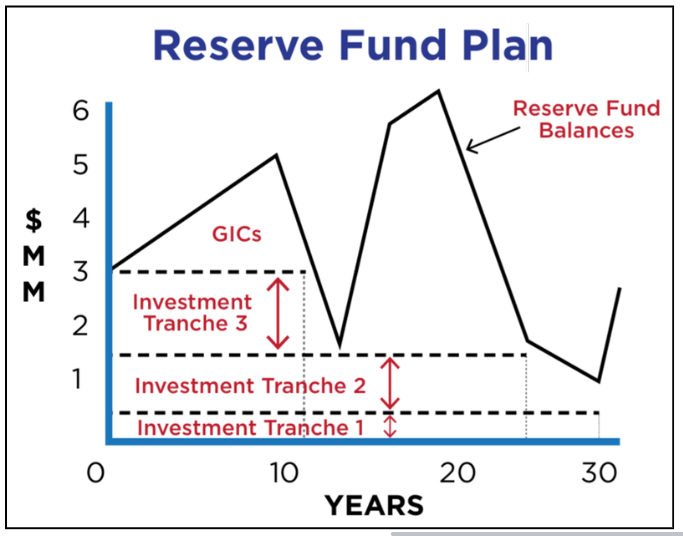
Reserve fund investments should be structured around the corporation’s long-term cash flow forecast, as set out in its Reserve Fund Plan. This forecast determines how much money can be invested and for how long.
A practical approach is to divide the reserve fund into investment tranches based on liquidity needs:
- Long-term tranche (funds not needed for decades): eligible for limited exposure to common shares
- Medium-term tranche: invested in bonds and preferred shares with appropriate maturities
- Short-term tranche: invested primarily in GICs and similar instruments
This structure aligns investment risk with time horizon and expected cash needs.
Boards investing beyond simple GIC portfolios should retain a qualified investment manager or pooled fund manager whose offerings comply with the CPA. Larger portfolios may justify customized management, while smaller corporations may find pooled funds more cost-effective. Selection of advisors should be done through a competitive proposal process. (See Fig1)
GIC Investment Strategy: Laddering for Return and Liquidity
GICs typically make up the largest portion of a reserve fund portfolio and play a crucial role in capital preservation and liquidity. A laddered GIC strategy is widely used because it is simple, effective, and flexible.
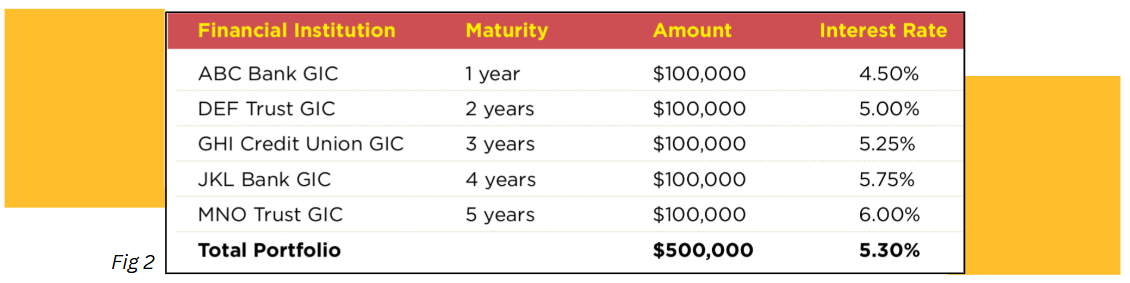
Under a laddered strategy, funds are divided evenly among GICs with staggered maturities—commonly one through five years. As each GIC matures, it is reinvested at the long end of the ladder, subject to current interest rates and cash needs.
Key benefits of laddering include:
- Higher average returns due to longer-term interest rates
- Annual liquidity as a portion of the portfolio matures each year
- Reduced interest rate risk by avoiding single-term concentration
Five years is typically the maximum GIC term, as this aligns with Canada Deposit Insurance Corporation (CDIC) coverage. (See Fig2)
Credit Quality and Deposit Protection
GIC policies should also address credit risk and deposit insurance:
- CDIC insures up to $100,000 (principal and interest) per depositor per institution
- To maximize yield while maintaining safety, deposits can be spread among multiple CDIC-member institutions
- Lower-rated banks and trusts often offer higher rates, with safety provided by CDIC coverage
- Provincial credit unions are insured by provincial guarantee systems, which vary by province
In Alberta, credit union deposits are fully guaranteed by the provincial government, but diversification across institutions and systems remains prudent. As portfolios grow, policies should permit larger deposits only with institutions rated “A” or better, and total exposure—including operating accounts—should be monitored.
Conclusion
Investing a condominium reserve fund requires balancing safety, liquidity, and long-term purchasing power within a clearly defined legislative framework. By adopting a formal investment policy, aligning investments with long-term cash forecasts, using professional advisors where appropriate, and employing proven strategies such as investment tranching and laddered GIC portfolios, boards can significantly reduce financial risk and improve the long-term sustainability of their reserve funds.
Careful governance and disciplined investing will help ensure that today’s contributions are sufficient to meet tomorrow’s repair and replacement obligations.
Walter Wakula is President of Foothills Global Capital Group Inc. and a consultant to the condominium industry specializing in financial management, budgeting, investment, and strategic planning. He holds a Bachelor of Commerce and MBA from the University of Calgary and a CCI (Hons) designation. With over 30 years of senior management and board experience, Walter is an active leader, educator, and writer in the condominium community.